
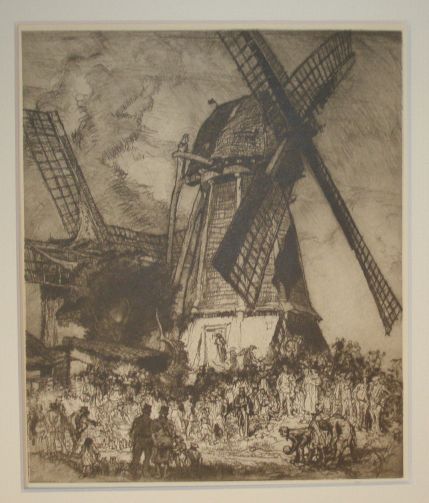
Sir Frank Brangwyn is one of the most prolific British artists of all time. His body of work features well over 12,000 pieces. Even more impressive than the sheer volume is the diversity. Works include paintings, illustrations, murals, stained glass, furnishings, and much more, so you can see how creative he was.
Brangwyn’s career was illustrious, earning fans all around the world. However, sadly he did not get as much love as he perhaps deserved in Britain. He made an effort to achieve more recognition here by producing works for Parliament’s Royal Gallery. Unfortunately, it became a controversial project and many believe it to be the catalyst for his eventual depression and seclusion.
The project
The story begins in 1926 when Brangywn got a commission to create a pair of panels for the Royal Gallery. He had backing from Edward Cecil Guinness, 1st Earl of Iveagh, the Irish/British philanthropist who became Lord Iveagh in 1891.
Originally, the commission was for Sir Frank Brangwyn to produce the pair of panels to commemorate the soldiers that gave their lives in World War One. He did two huge scenes with life size soldiers advancing into battle alongside a tank. Unfortunately, the Lords were not happy with the work. They were critical of the depressing subject and dark colours. So, in 1928 they officially refused the works. They found a home at the National Museum in Cardiff.
After the first set-back, Lord Iveagh gave Brangwyn a second commission to create panels to celebrate the British Empire. He did 16, covering an incredible 3,000sq/ft. It took five years to create them, including a massive amount of preparatory drawings and studies such as small paintings and sketches of local flora, fauna, and people in different parts of the Empire.
The British Empire Panels were a triumph for Brangwyn, showing his skills on a massive scale. However, there was more controversy again. Five panels were initially hung in the Royal Gallery. But, following a backlash from peers and the media, The House of Lords refused them in 1930. They were critical of the amount of colour and some of the subject matter, particularly nudity.
Interestingly there was a battle to give the panels a home. Cardiff and Swansea both had bids to take them, citing that Sir Frank Brangwyn was Welsh. Swansea’s bid was more attractive because they were in the process of building the iconic Guildhall. Their proposal was to alter the design to accommodate the art. The Assembly Hall, now the Brangwyn Hall, became the home of the panels in 1934.
The fallout
The whole experience with the panels had an awful impact on Brangwyn. He suffered depression and began donating his work to various museums and galleries in the 1930s. Notably, he gave the preparatory work for the panels as a gift to Swansea; it has a home at Glynn Vivian Art Gallery. He did win recognition and a knighthood in 1941 though. However, eventually he became a recluse and passed away in 1956.
Do you want to add a piece by Sir Frank Brangwyn to your collection?
Charter Prints has some amazing pieces by Brangwyn. They would be perfect for any fine art collection. You can have a look here. Then, if you to order any, you can contact us.